Last Updated on August 7, 2026 by Tanya
If you’ve ever stood in a shop holding a leather bag and thought “but is the vegan one actually better?” — you’re not alone. It’s one of the most common questions in ethical fashion, and the answer is more nuanced than a simple yes or no.
The short version? Animal leather is significantly worse for the environment. But not all vegan leather alternatives are equal — and some are far greener than others. Let’s break it down properly, with actual numbers.
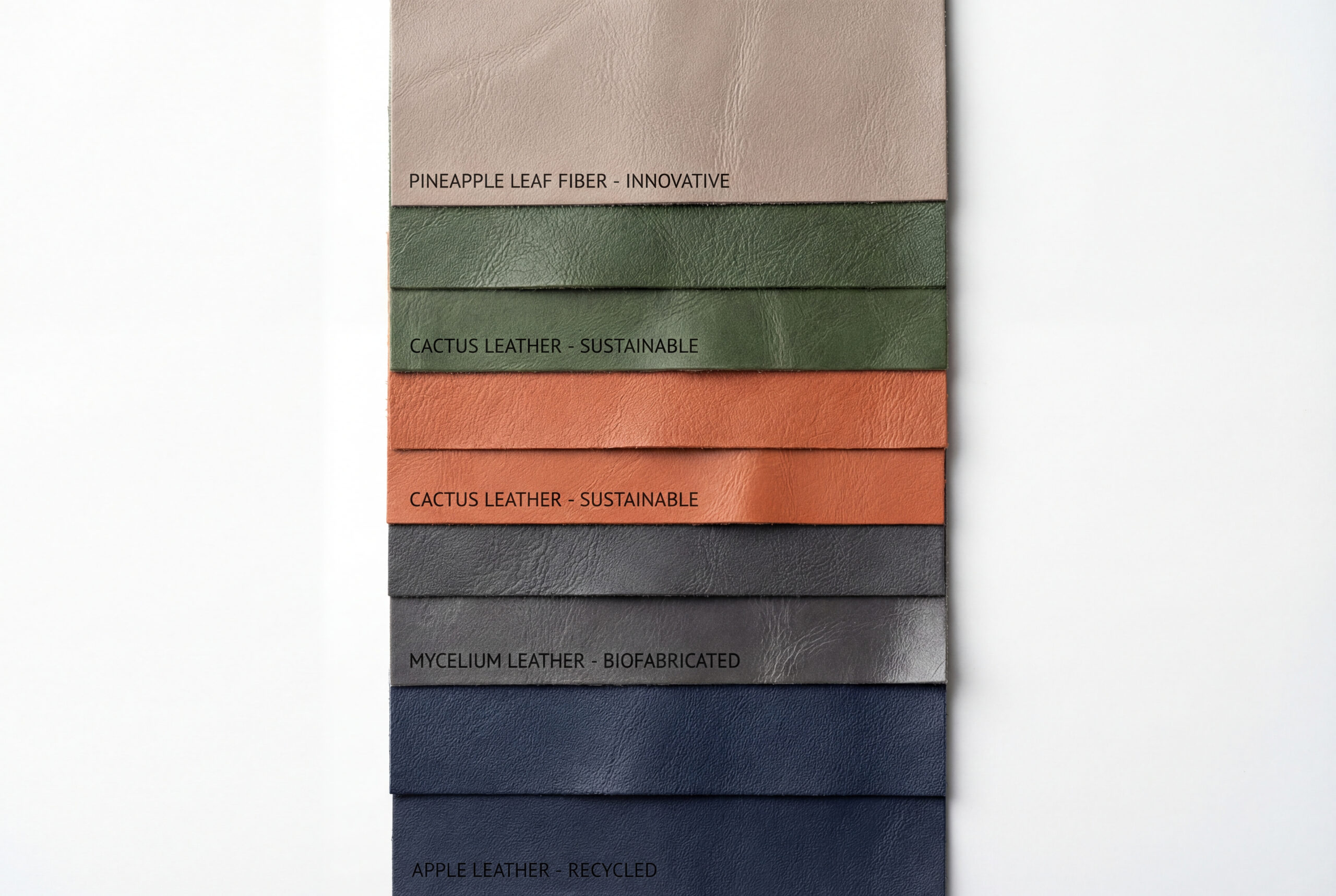
If you want the full rundown of what each of these materials actually looks, feels, and wears like, I’ve covered that in detail in my Vegan Alternatives to Leather guide .
The Problem with Animal Leather
Most people know that animal leather has ethical concerns. But the environmental damage runs deeper than many realise.
Greenhouse Gas Emissions
Bovine leather is one of the most carbon-intensive materials in fashion. A comprehensive meta-analysis from Cornell University found a combined greenhouse gas footprint of around 190 kg of CO₂ equivalent per kilogram of finished bovine leather — with vegan leather averaging just 14.9 kg CO₂e/kg in comparison, roughly 8% of the animal leather figure.
Looking at it per square metre (a more practical measure for bags and accessories), one square metre of cow leather generates approximately 110 kg of CO₂e — making it nearly seven times more climate-impactful than synthetic vegan leather by the same measure.
Where do those emissions come from? Roughly 58–68% of animal leather’s footprint comes from the farming stage — the cattle themselves. Cows produce 550–700 litres of methane every single day, and methane is around 25 times more potent as a greenhouse gas than CO₂. The tanning and processing phase adds a further significant layer of impact on top.
The Tanning Problem
Turning raw hide into leather requires intense chemical processing. Around 80–90% of global leather is tanned using chromium sulphate — a heavy metal that is hazardous both to human health and to the environment. Studies suggest that up to 70% of chromium salts used in tanning can become wastewater pollutants, contaminating local waterways and soil, and posing serious risks to the workers and communities near tanneries.
The Higg Materials Sustainability Index (MSI) — the fashion industry’s most widely used environmental benchmarking tool — ranks bovine leather as the third most environmentally impactful material to produce from cradle-to-gate, behind only silk and alpaca wool fabric. The Sustainable Apparel Coalition, which develops the MSI, has defended this data robustly — because the leather industry has pushed back hard against it.
Is Leather Really a By-product?
One of the leather industry’s most persistent marketing claims is that leather is simply a sustainable by-product of the meat and dairy industries — that without leather, those hides would just be waste. This framing is misleading.
A by-product becomes a co-product the moment it generates meaningful profit. The leather goods market is projected to reach nearly $630 billion in value by 2030 — this is not a waste stream being charitably recycled. It is a profit-driven industry in its own right, and one that financially subsidises animal agriculture in significant ways.
Consider the dairy industry: only female cows produce milk, so male calves born into dairy systems are largely without value to farmers — except to be killed for veal and for their hides. Slaughterhouses have reported multi-million dollar losses when hides aren’t selling, often attributing this directly to the rise of leather alternatives. Without the revenue from leather, the economics of both beef and dairy production would shift considerably.
It’s also worth saying — leather isn’t just a cow problem. While cattle hide is the most common source, leather is also made from pigs, goats, sheep, and even more exotic animals like snakes, crocodiles, ostriches, and stingrays. Some of these “exotic” leathers come from animals that aren’t farmed at all, but caught from the wild, which raises its own set of concerns around conservation and animal welfare. Once you start looking at leather as a category rather than just “cow skin,” the scale of it becomes much harder to ignore.
For this reason, there is no honest accounting of leather’s environmental impact that excludes the emissions from animal farming. The leather industry would prefer to be responsible only for tanning — but the two cannot be cleanly separated.
Deforestation and Land Use
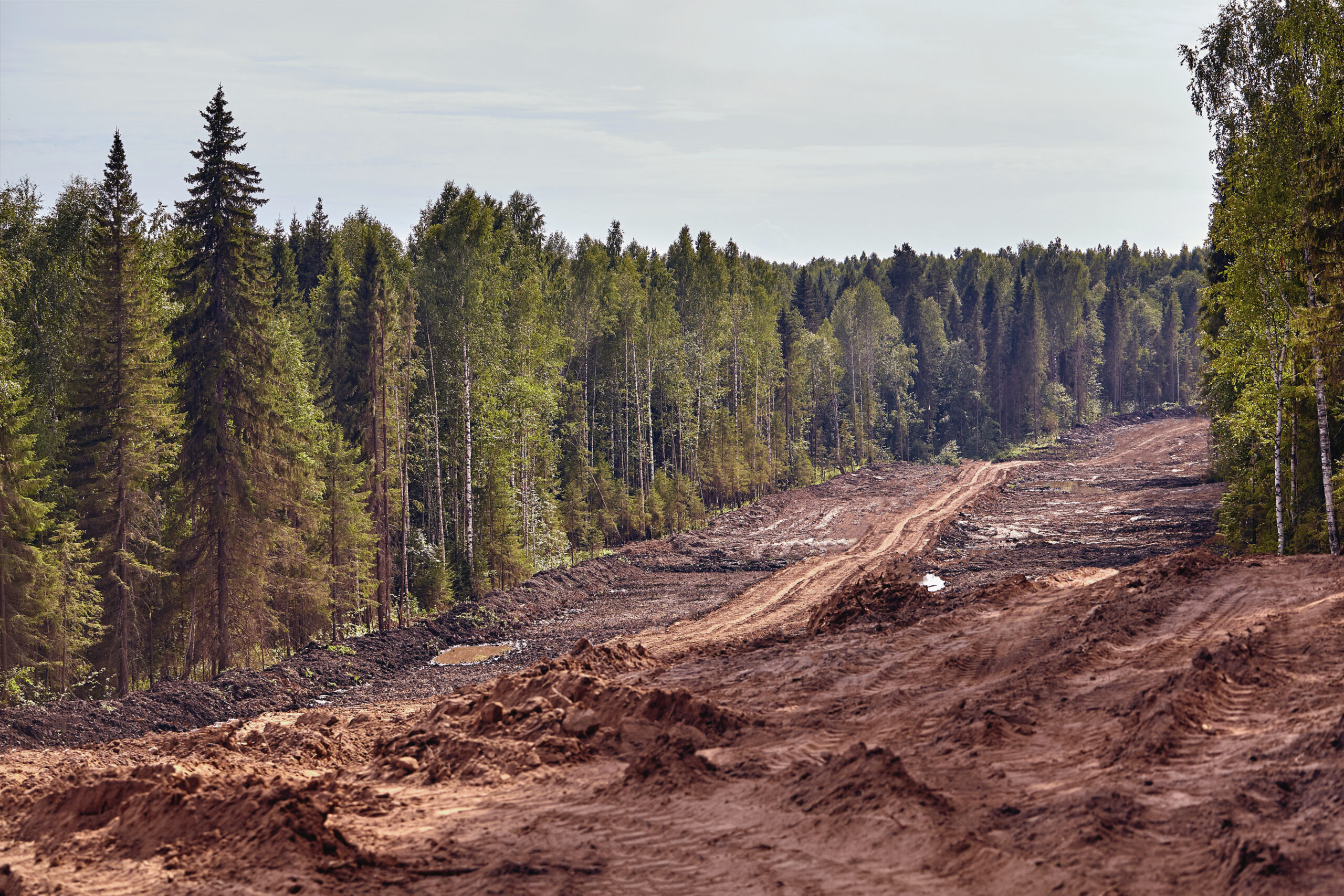
Animal agriculture is one of the leading drivers of deforestation globally. Some estimates suggest a single Brazilian leather handbag can be linked to as much as 1,000 square metres of once-biodiverse land being cleared for cattle grazing. This loss of habitat has cascading effects on biodiversity, carbon sequestration, and local ecosystems.
Water Use
The leather supply chain is also extraordinarily water-intensive. Growing feed crops for livestock, combined with the water required during tanning, makes leather one of the thirstiest materials in fashion.
What Does This Mean for Your Bag, Shoes, or Jacket?
It helps to make these numbers concrete. Using data on how much leather is required to make different products, researchers at Collective Fashion Justice have calculated the approximate actual carbon cost of common leather goods — comparing animal leather to PU synthetic leather at the per-product level.
| Product | Animal leather CO₂e | PU vegan leather CO₂e |
|---|---|---|
| Handbag | ~100 kg | ~14 kg |
| Shoes | ~41 kg | ~6 kg |
| Jacket | ~176 kg | ~10 kg |
The Surprising Truth About Landfill
You may have heard the argument: “Wouldn’t it be worse to throw those hides in landfill?” It’s a common deflection from both the leather industry and well-meaning sustainable fashion voices.
Based on the data, the answer is actually no. Researchers calculated that sending an unprocessed cowhide to landfill produces around 94 kg of CO₂e per square metre — less than the 110 kg generated by turning it into leather. This is because the tanning and chemical processing stage alone accounts for roughly 17 kg CO₂e/m², and the finished leather will eventually be discarded or incinerated anyway.
In other words, just the processing of raw hides into leather generates about as much emissions as producing faux leather from scratch. The uncomfortable implication: even if we set aside all the farming emissions, producing vegan leather is still a more climate-responsible choice than processing hides that already exist.
So What About Vegan Leather?
Here’s where it gets interesting — because “vegan leather” covers an enormous spectrum, from petroleum-based plastics to innovative plant-based materials that use agricultural waste as their foundation.
Not all vegan leathers are created equal, and it’s worth knowing the difference.
PVC and PU Synthetic Leather: The Complicated Middle Ground
The most common vegan leather you’ll encounter — especially in fast fashion — is made from polyvinyl chloride (PVC) or polyurethane (PU). Both are plastic-based materials derived from fossil fuels.
The honest truth about PVC and PU:
- They have a significantly lower carbon footprint than animal leather — roughly 7–15.8 kg CO₂e per square metre compared to animal leather’s ~110 kg CO₂e/m²
- They use far less water and land
- They don’t require animal agriculture
- But they are derived from non-renewable fossil fuels
- They are not biodegradable and will persist in landfill
- PVC in particular can release toxic chemicals during production and disposal
- Synthetic fabrics are among the biggest sources of microplastic pollution in the ocean
PU leather is the lesser of the two evils — it’s less toxic to produce than PVC and has a lower overall environmental footprint. But neither is a long-term sustainable solution. They’re a meaningful improvement over animal leather, but not the end goal.
Plant-Based Leathers: The Real Revolution
This is where things get genuinely exciting. Over the past decade, innovators around the world have been developing leather alternatives made from agricultural waste and rapidly renewable plants — materials that sidestep both animal exploitation and fossil fuels.
Here’s a look at the main ones, and how they compare environmentally.
🍎 Apple Leather (AppleSkin™)
What it is: Made from the pulp and cores left over from apple juice and cider production — waste that would otherwise go to landfill or compost.
Environmental profile: Because it’s built on industrial waste, apple leather has a very low raw material footprint. Production uses considerably less water and energy than animal leather, and it doesn’t require dedicated land or crops.
The catch: Like most plant-based leathers currently on the market, apple leather is typically bonded to a textile backing and coated with a polyurethane layer to achieve the durability and water resistance needed for bags and accessories. This means it isn’t fully biodegradable — though the PU content is significantly lower than in fully synthetic leathers.
Overall verdict: A strong choice. It gives agricultural waste a valuable second life and has a much lower environmental footprint than animal leather.
🌵 Cactus Leather (Desserto®)
What it is: Developed in Mexico from the nopal (prickly pear) cactus, Desserto® is one of the most talked-about vegan leather innovations of recent years.
Environmental profile: Nopal cactus is remarkably low-impact to grow — it requires no irrigation (it thrives on rainwater alone), no herbicides, and actually absorbs CO₂ while growing. The plants are harvested every 6–8 months without being uprooted, so the same plants continue growing and sequestering carbon over time. Desserto has released a Life Cycle Assessment (LCA) showing very competitive environmental figures.
The catch: Like apple leather, Desserto currently uses a bio-resin that contains some PU component, meaning it isn’t yet fully biodegradable. However, the founders have stated a goal of phasing this out.
Overall verdict: One of the best options currently available in terms of raw material sustainability. The cactus itself is extraordinarily low-impact; the remaining question is around the finishing stage.
🍍 Pineapple Leather (Piñatex®)
What it is: Made from the fibres in pineapple leaves — a byproduct of pineapple harvesting that would otherwise be burned or left to rot in the field. Developed by Dr Carmen Hijosa and produced by Ananas Anam.
Environmental profile: Piñatex has an overall ecological impact claimed to be almost two-thirds less than synthetic leather. It also provides additional income for farming communities in the Philippines, where the pineapple leaf fibres are sourced. The raw material production is genuinely low-impact — no additional land, water, or pesticides beyond what the pineapple farming already uses.
The catch: To achieve durability, Piñatex requires a polyurethane resin coating, which means the finished product is not biodegradable.
Overall verdict: A genuinely circular approach to raw materials, with strong social sustainability credentials for farming communities. The PU coating is the remaining limitation.
🍄 Mushroom / Mycelium Leather (Mylo™, Reishi™)
What it is: Made from mycelium — the root structure of mushrooms — grown on agricultural waste like corn husks. The mycelium is harvested in a matter of weeks, compressed, and tanned using natural processes.
Environmental profile: Mycelium grows rapidly (weeks rather than years), requires minimal land and water, and produces a material that can be genuinely biodegradable. LCA studies for Reishi by MycoWorks have shown a promising environmental profile. However, the picture varies depending on whether an active or passive growth process is used — active processes require CO₂ to be pumped into the growing chamber, which adds to the footprint.
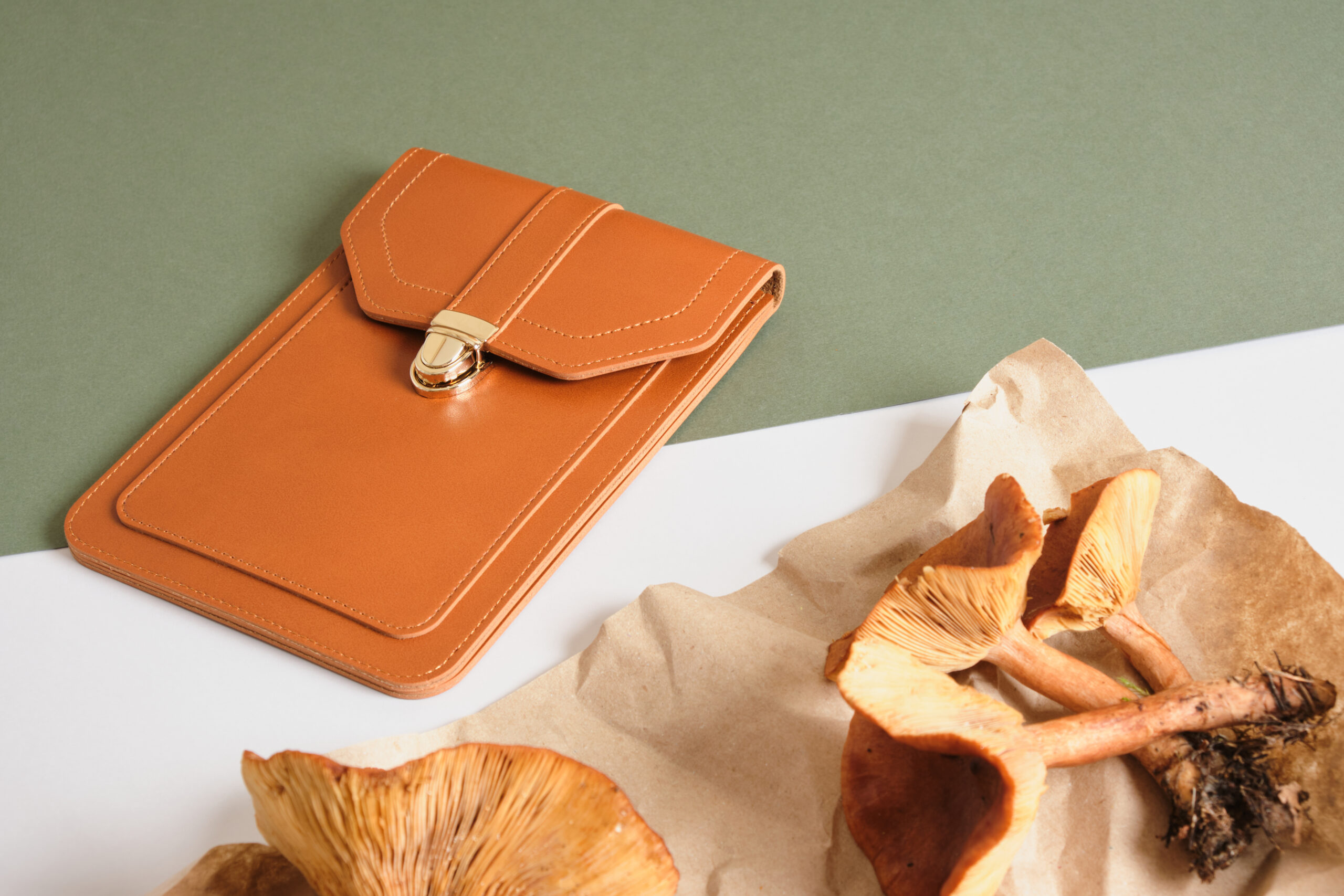
The catch: Mycelium leather is currently the most expensive and least commercially scalable of the plant-based options. Bolt Threads, the maker of Mylo (used by Stella McCartney and Hermès), paused commercial production in 2023 due to the challenges of scaling the technology.
Overall verdict: Extremely promising in theory and strong on biodegradability. Still finding its feet commercially, but one to watch.
🍇 Grape Leather (Vegea)
What it is: Made from grape marc — the skins, stalks, and seeds left over from winemaking. Developed by Italian company Vegea.
Environmental profile: Like apple leather, grape leather makes use of a genuine waste stream from an existing industry (Italy produces enormous volumes of winemaking waste). The raw material footprint is very low. Vegea’s material has been used by high-fashion brands including H&M’s Conscious Collection.
The catch: Current versions use some PU binder, though Vegea has been developing more bio-based alternatives.
Overall verdict: Another excellent example of waste-stream upcycling with a compelling environmental story.
🌿 MIRUM® (Natural Fiber Welding)
What it is: MIRUM is in a category of its own. Developed by US company Natural Fiber Welding, it is the first commercially available leather alternative made with zero plastic inputs — no PU, no PVC, nothing synthetic. It’s made entirely from plant-based materials including natural rubber, plant oils, natural pigments, and cork.
Environmental profile: The numbers here are remarkable. MIRUM’s carbon footprint assessment found that producing one square metre results in as little as 0.84 kg CO₂e — rising to 2.1 kg CO₂e with a cotton fabric backer. To put that in context:
- Nearly 14 times smaller than chrome-tanned animal leather
- Over 7.5 times smaller than conventional synthetic leather
- Almost 4 times smaller than partly bio-based PU leathers
MIRUM is also fully recyclable and designed to return to the earth at end of life. It uses no water in production and sources FSC-certified rubber.
The catch: It is currently limited in availability and tends to come at a premium price point. Not all brands have access to it yet.
Overall verdict: The gold standard of vegan leather sustainability right now. If this is what your bag is made from, you can feel genuinely good about it.
The Takeaway
If you’re choosing between animal leather and any form of vegan leather, vegan leather wins on environmental impact — by a significant margin, even when that vegan leather contains plastic.
But within the vegan leather world, the spectrum is wide. The plant-based materials — particularly those built on agricultural waste — represent a genuinely exciting shift towards circular, low-impact fashion. And MIRUM sits at the top of the pile right now in terms of raw environmental credentials.
The uncomfortable truth is that most of us are choosing between imperfect options. Plant-based leathers with PU coatings aren’t perfect — but they’re a meaningful step forward, and the technology is improving rapidly. The brands and innovators working on these materials are doing genuinely important work.
What you can do? Ask questions. Look for transparency from brands about their materials. Seek out certifications and published LCAs where they exist. We’re watching the future of materials being written in real time — and it’s looking like vegan is where the future of fashion is heading.🌱
Curious about which luxury brands are doing this well? See our round-up of the Best Luxury Vegan Handbag Brands.